
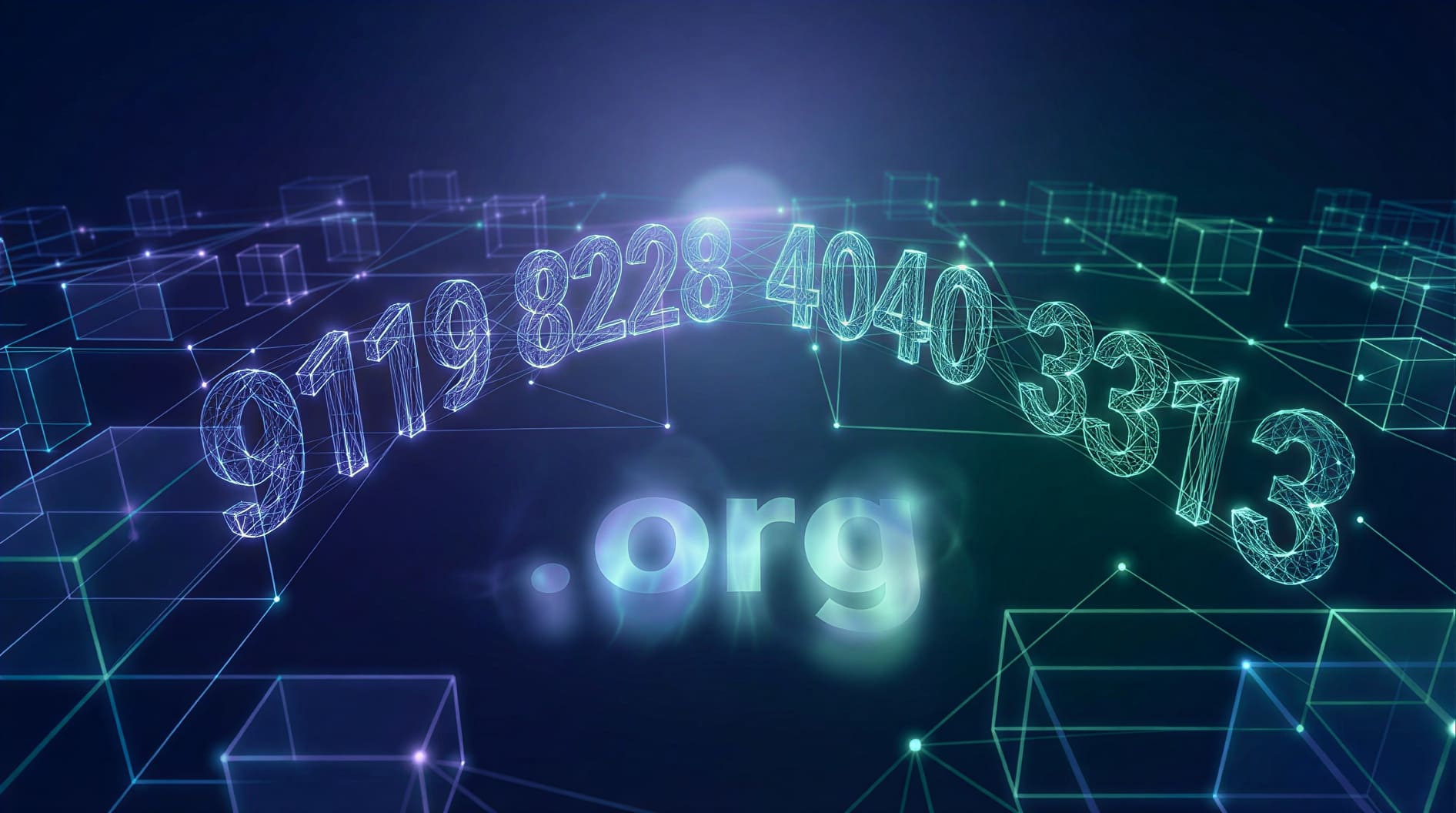
The Liquidity and End-User Dynamics of NNNN.org Domains
The Mathematical Baseline of Four-Number Domains
There are exactly 10,000 four-number combinations. This finite supply is the foundational logic behind NNNN domain investing. In the .com extension, these assets trade like liquid commodities, driven heavily by wholesale markets and international investor demand. They are evaluated on sheer brevity and universal recognition—math does not require translation. But when you move the same numeric sequence to the .org extension, the asset class fundamentally changes. A four-number .org is not a commodity; it is a highly specific digital identifier.
The .org Variable: Trust Versus Commercial Intent
The .org ecosystem carries a specific historical context. Originally designated for non-profits and charities, its application has shifted. Today, it operates as the de facto extension for open-source software, decentralized autonomous organizations (DAOs), and community ledgers. A commercial retail entity buys a .com. An infrastructure protocol defaults to a .org. This distinction dictates how NNNN.org assets are priced and sold. The challenge for investors is overcoming the traditional perception of .org when analyzing demand from data-focused ventures. The end-user is rarely a traditional business; it is usually a technical community or a decentralized project that requires a neutral, non-commercial trust signal.
Mapping the NNNN.org End-User
A numeric sequence paired with a .org extension functions less as a traditional brand and more as a routing number for the web. The brevity complements data-centric use cases. In blockchain ecosystems, numeric domains serve as wallet addresses, token identifiers, or repositories for Ethereum Improvement Proposals (EIPs). In gaming and online communities, they operate as memorized server IPs or community hub access points. Data and analytics platforms use them as short access endpoints for dashboards. The intrinsic value lies in the domain operating as a frictionless digital coordinate rather than a human-readable word.
Portfolio Context and Pattern Analysis
To understand how pricing and demand fluctuate within the 10,000 available combinations, we must evaluate specific structural patterns. The secondary market value of an NNNN.org relies heavily on its internal sequence and potential technical overlap.
- 8228.org and 9119.org: These are ABBA palindromes. Symmetrical numbers are visually striking and inherently easier to memorize. Protocol teams often acquire symmetrical shortcodes because they look balanced on technical documentation and command-line interfaces.
- 1152.org: This specific sequence holds technical significance. In computing, 1152 appears frequently in screen resolutions and historical baud rates. A domain with inherent mathematical or computational relevance directly targets developer communities building open-source tools.
- 8112.org: This represents an ABBC pattern. It also contains 112, which is the standard emergency telephone number in the European Union. Routing significance like this creates isolated pockets of demand from civic or infrastructural organizations requiring recognizable shortcodes.
- 6778.org: This sequence utilizes ascending elements and a double digit. While not a pure straight, ascending structures imply progression or sequence, making them viable endpoints for continuous data tracking or public-facing analytics dashboards.
- 8569.org: This is a randomized, non-pattern sequence. Domains like this represent the baseline valuation floor for NNNN.org assets. They are acquired primarily for their sheer character count, utilized for raw data routing where visual symmetry matters less than the strict technical requirement of a four-character limit.
The Investment Landscape: Liquidity vs. Hold Time
Domain investors transitioning from .com to .org numeric assets often miscalculate the liquidity profile. NNNN.coms have an active wholesale market. NNNN.orgs do not. You acquire an NNNN.org to hold for end-user acquisition. The market dynamics dictate a lower entry cost compared to .com, but a significantly longer hold time. Value drivers are highly specific: alignment with a unique project, inherent mathematical scarcity, and pattern recognition. Risk mitigation in this asset class requires a strict acquisition discipline—buying at wholesale floors and refusing to overpay for non-pattern sequences unless an end-user trend specifically supports it.
The Expanding Role of Numeric Identifiers
The broader digital infrastructure is shifting toward machine-readable ecosystems. As automation scales, artificial intelligence agents and large language models parse numeric identifiers far more efficiently than language-based domains. Simultaneously, decentralization trends are creating an increasing need for concise, non-language-specific nodes. The .org zone is currently adapting to these technical shifts, attempting to retain its core trust signals while serving as the routing layer for decentralized networks.
Final Assessment
As web architecture transitions from human-readable consumer platforms to machine-readable data endpoints, the utility of a four-number .org is quietly evolving. The underlying infrastructure demands concise, neutral identifiers that operate independently of language barriers. The critical question for investors is whether the secondary market will continue to price these assets based on their legacy status as traditional domain names, or eventually reprice them as finite digital coordinates within a decentralized web.
Share
Mentioned Domains